

Two homes with the same TV provider can have different channel numbers. They can have different local stations. They can even have access to different channels altogether, with one home getting a regional sports network the other does not.
Most people assume a cable provider has one national channel lineup, the way Netflix has one library. That assumption is wrong, and it explains why generic “channel lineup” lists found online so often disagree with what shows up on the TV at home.
The actual answer is that a cable lineup is determined by five factors working together: the provider, the physical address, the local cable system serving that address, the package tier the customer subscribes to, and regional broadcast rights. Change any one of these and the lineup can shift.
Here is how each factor works.
Address Matters More Than Provider Name
Cable television in the United States is a local business that wears national branding. Xfinity, Spectrum, Optimum, and Cox all operate dozens of regional cable systems, and each system has its own channel map. When two homes subscribe to “Xfinity,” they are technically subscribing to whichever local Xfinity system serves their address.
The provider name on the bill is the same. The underlying infrastructure delivering channels is not.
This is the single biggest source of confusion for cable subscribers, and it is also the reason channel lookup tools that do not ask for an address are nearly useless. Without the address, the lookup has no way to know which local system applies.
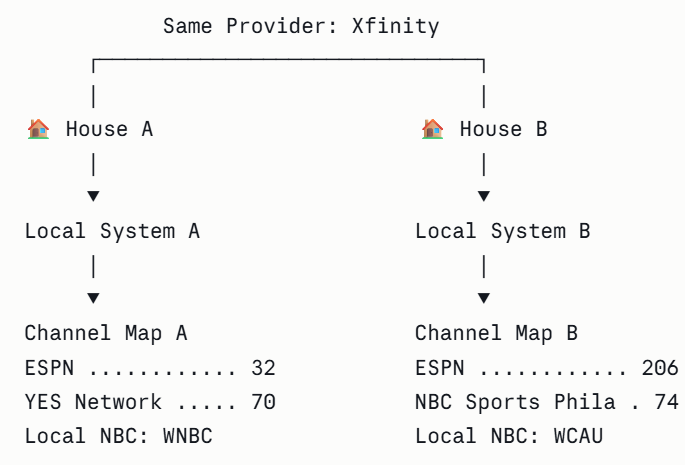
The rest of this article explains the specific mechanisms that cause those local systems to differ.
Headends and Local Cable Systems
A cable headend is the local distribution facility that pulls in television signals from satellite, processes them, and pushes them out to neighborhood homes through coaxial or fiber lines. Each headend serves a defined geographic area, and each headend has its own channel mapping.
Two homes that look like they should be on the same system can sit on different headends if they are near a boundary. This is more common in metropolitan areas where multiple headends serve adjacent neighborhoods, and in suburbs that grew through the merger of older cable franchises.
When channel numbers differ between two homes in nearby neighborhoods, a headend boundary is usually the reason.
Local Broadcast Stations and TV Markets
Local broadcast stations are tied to TV markets, often called Designated Market Areas, or DMAs. Those market boundaries help determine which ABC, CBS, NBC, FOX, PBS, and other local stations a provider carries in a given area.
Move 30 miles in some parts of the country and the DMA changes. The local NBC affiliate switches call signs. The channel that was WNBC in one home becomes WVIT or WCAU in another. Same network. Different station. Different programming during local news hours.
This is why “what channel is NBC on Xfinity” has no single answer. There are roughly 200 NBC affiliates nationwide, and which one appears on any given cable system depends entirely on where that system sits inside the DMA map.
Regional Sports Network Territories
Regional sports networks are governed by some of the most restrictive geographic licensing in television. MLB, NBA, and NHL teams sell broadcast rights inside specific territories, and cable providers can only carry the RSN that holds rights for the home where the signal terminates.
A home in northern New Jersey on Xfinity gets YES Network, which holds Yankees rights. A home in southern New Jersey on the same Xfinity gets NBC Sports Philadelphia, which holds Phillies rights. The provider is identical. The available sports channels are not.
This is a frequent source of frustration for sports fans who move within a state, or even within a metro area, and discover that their team’s RSN is no longer available. The cable provider has not changed anything. The territory line has.
Package and Tier Differences
Even on the same headend, two homes can see different lineups if they subscribe to different packages.
ESPN appears on Spectrum TV Select Signature but not on Spectrum TV Stream. Discovery Family appears on some Xfinity tiers and not others. Premium movie channels like HBO and Showtime are add-ons rather than base channels on most providers.
Two neighbors with identical addresses on identical headends can therefore have entirely different channel guides, because one is paying for a higher tier or different add-ons.
Legacy Systems From Mergers and Acquisitions
The American cable industry has been through three decades of consolidation. Charter bought Time Warner Cable. Comcast absorbed dozens of smaller operators. Optimum, formerly Cablevision, has merged in regional systems on both coasts.
When one cable company buys another, the channel maps from the acquired system often persist for years. Numbering schemes do not always get rationalized. Some markets still run on lineups inherited from cable systems that were absorbed in the early 2000s.
This is why certain small markets show channel orderings that look nothing like the parent provider’s flagship cities. The market is technically Xfinity or Optimum, but the channel map underneath is from a predecessor company.
Why Online Lineup Lists Often Show the Wrong Information
Most websites that publish “channel lineup” articles list a provider’s channels nationally, without asking for an address. These lists draw from press releases, marketing materials, or a single market’s lineup that has been treated as universal.
They are usually wrong, or at least incomplete, for any specific address.
A lineup tool that does not ask where the customer lives cannot account for headend boundaries, DMA-specific local stations, RSN territories, or legacy market numbering. It produces a generic answer that may match the actual lineup in the city the writer happened to research, and may not match anywhere else.
After reviewing lineup data across multiple providers and markets, one pattern stands out: the difference between an accurate lineup and a generic one almost always comes down to whether the source asked for an address before producing the answer.
How to Check Your Actual Lineup
The reliable way to find a real channel lineup is to use the provider’s official address-based lookup tool. Each major provider offers one on their own website, and these are the only sources that account for the local system serving a specific address.
For cable providers like Xfinity, Spectrum, Cox, and Optimum, the lookup requires a service address or zip code and returns a lineup specific to the local system. For satellite providers like DirecTV and DISH, base channel numbers are usually more consistent nationally, but local broadcast stations and regional sports availability still depend on the customer’s zip code or service address.
For any provider, treat third-party “channel list” articles as a starting point, not a final answer. Before trusting any online lineup, check the following:
- Does the source ask for a zip code or service address before showing channel numbers?
- Does it specify which package or tier the lineup applies to?
- Does it list local broadcast stations by call sign, or only by network name?
- Does it identify which regional sports network applies to the area?
- Is there a visible “last updated” date on the page?
If the answer to most of these is no, the lineup is likely a generic national list and may not match the actual channels at any specific address.
The Short Version
A cable lineup is not a national list. It is the intersection of a provider, an address, a local system, a package, and the regional rights that apply to that location. Two homes that share even four of those five inputs can still see different channels.
This is a feature of how the American television industry has been built, not a bug. It also explains why the most useful channel lookup tools are the ones that take a specific address and return a specific lineup, rather than the ones that promise a universal answer.
Leave a Reply