

The same TV channel can appear on completely different numbers in different cities, even when the provider is the same. ESPN may sit in the 30s on one cable system, the 200s on another, and somewhere else again after a provider merger or a lineup refresh. Move from one metro area to another and the channel guide essentially gets reshuffled.
This is one of the most consistent sources of confusion for cable subscribers. People remember “ESPN is channel 32” the way they remember a phone number, then move across the country and find themselves typing the old number into a remote that does not respond.
The reason is simple, even if the result feels chaotic: channels do not own their numbers. The local cable system does.
Channels Do Not Own Their Numbers
ESPN is a channel. It is not a channel number. The same applies to CNN, Fox News, HGTV, the Discovery Channel, and every other cable network. None of them have a fixed national channel number, the way a federal area code is fixed to a region.
What actually happens is that each local cable system builds its own channel map, deciding which slot each network gets. ESPN might land somewhere in the low triple digits on one system, in the 30s or 40s on another, and on a completely different number after a market is acquired by a different cable company. The channel itself does not move. The system underneath assigns it differently.
This is why channel-number lookups that do not ask for an address cannot give a real answer. Without knowing which local cable system applies, the number is not reliable.
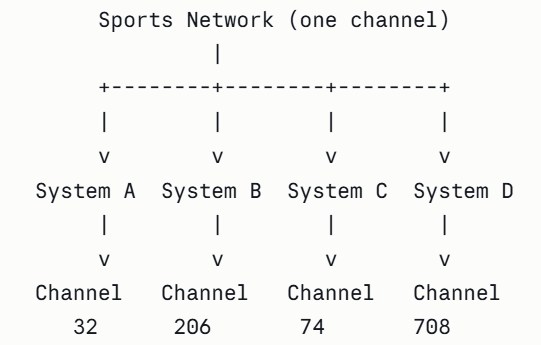
Local Cable Systems Build Their Own Channel Maps
Most cable systems follow rough conventions when assigning numbers, but every system makes its own choices within those conventions.
The lowest numbers, typically 2 through 13, are usually reserved for local broadcast stations. The next range, often 14 through 99, tends to hold widely-distributed basic cable networks. The 100s through 400s are typically used for digital tier channels, HD versions, and category groupings like sports, news, and movies. Numbers above 500 are often premium channels and add-on packages.
Within those ranges, individual systems make their own decisions. One system might cluster all sports channels in the 200s. Another might split sports into a sports tier starting at 400. One might give HD channels their own number range above 700; another might assign HD channels a number close to the SD version.
None of this is standardized across the industry. The conventions are loose, and within them, every cable system has historically made its own ordering decisions based on its own market, its own subscriber feedback, and its own legacy.
Why Local Broadcast Channels Get the Low Numbers
The reason channels 2 through 13 are typically reserved for local broadcast stations is historical, not arbitrary. Before cable, viewers identified many local stations by the channel number they saw on the TV set, such as “Channel 4” or “Channel 7.” That number was how households remembered the station and how stations themselves marketed their identity in the local market.
When cable systems added those local stations, they often kept those familiar positions so subscribers did not have to relearn where their local channels lived. The local “Channel 4” station stayed on channel 4 of the cable lineup. This preserved viewer habits and avoided the chaos of mass renumbering.
In the digital era, the number a viewer sees on screen may be a virtual channel rather than the station’s actual broadcast frequency, but the habit of giving local stations familiar low numbers continued to shape cable lineups. The result is that local broadcast channel numbers are tied to the geography of each market, not to any national standard. The local NBC affiliate appears on different numbers in different cities, because the historical assignments were different in each market. The same network, different number, depending on the city.
Why HD and SD Versions Add Another Layer of Confusion
For most of the past two decades, cable systems carried both standard-definition and high-definition versions of major networks. ESPN existed as both an SD channel and an HD channel, often on different numbers. The same was true for nearly every popular network.
Different cable systems handled this differently. Some assigned the HD version a number close to the SD version, like adding 800 to the original. Some grouped all HD channels together in a separate high-numbered block. Some gave the HD version a completely independent slot.
More recently, several major cable providers have moved toward a single-number system, where the cable box automatically delivers HD to HD-capable customers without requiring a separate channel number. Other providers still maintain dual numbering. The result is that “what channel is ESPN” can have two answers on one system, one answer on another, and a different one again on a third, even before factoring in city-to-city variation.
Why Mergers Leave Old Numbering Schemes Behind
The American cable industry has been through three decades of consolidation. Charter Communications absorbed Time Warner Cable. Comcast acquired dozens of regional operators including AT&T Broadband and parts of Adelphia. Optimum, formerly Cablevision, has merged in regional systems on multiple occasions.
When one cable company buys another, the channel maps in the acquired markets do not always get rationalized. Subscribers in those markets are used to specific channel numbers, and renumbering thousands of channels generates customer service complaints, confused viewers, and lost satisfaction. So the new parent company often leaves the old map in place, sometimes for years, sometimes indefinitely.
The practical effect is that two markets nominally on the same provider can have entirely different number assignments because they came from different predecessor systems. A channel on a former Time Warner Cable market under Charter ownership might sit on a different number than the same channel on a long-time Charter market, even though both are now branded as Spectrum. The brand on the bill is the same. The underlying channel map is not.
Why Satellite and Streaming Feel More Consistent
Satellite providers like DirecTV and DISH use a more nationally standardized channel map than cable providers. Their base channel numbers are usually more consistent from state to state, although local broadcast stations and regional sports networks still depend on the customer’s location.
Streaming services go even further. YouTube TV, Hulu Live, Sling, and similar platforms do not use channel numbers at all in the traditional sense. The channel guide is searchable, channels are organized by name, and the entire concept of “channel 32” or “channel 206” disappears.
This is why moving from cable to streaming, or from cable to satellite, can feel like such a change. The fragmented local-cable numbering system was always a quirk of how cable infrastructure was built, not a property of television itself. Newer delivery methods do not inherit that quirk.
How to Find the Right Channel Number for Your Address
The reliable way to find a real channel number is to use the provider’s official address-based lookup tool. The lookup needs to know which local cable system serves the specific address before it can return an accurate number.
Generic “what channel is ESPN” articles online are often incomplete for a specific home, because they cannot account for which local system applies. They list a number that was correct in the writer’s market, or in a press release, and present it as if it were universal.
Across address-specific lineup data reviewed for this project, one pattern is consistent: there is no national answer to “what channel is X on Y.” There is only an answer for X on Y at a specific address. The systems underneath are local, and so are the numbers.
The Short Version
Channel numbers are assigned by local cable systems, not by the channels themselves. Local broadcast stations get the low numbers because of over-the-air broadcasting history. HD and SD versions add confusion because providers handle them differently. Mergers leave old number maps in place because renumbering would frustrate existing subscribers. Satellite and streaming feel more consistent because they do not use the same fragmented local infrastructure.
The same channel having different numbers in different cities is not a glitch. It is the predictable result of how cable television was actually built.
Leave a Reply