

Most cable subscribers have never thought about where their TV signal actually comes from. The coaxial cable enters the wall, the box is plugged in, and the channels appear. The infrastructure behind that simple experience involves national programming origination, long-distance transport networks, a local cable provider building called a headend, fiber and coaxial distribution through the neighborhood, and a final drop line into the house. Each step has its own role, and each step has its own failure modes.
This guide walks through that infrastructure path from end to end. Understanding it makes several common cable mysteries less confusing, including why channel lineups differ by address, why outages affect some homes but not others, and why local channels behave differently from national networks even on the same wire.
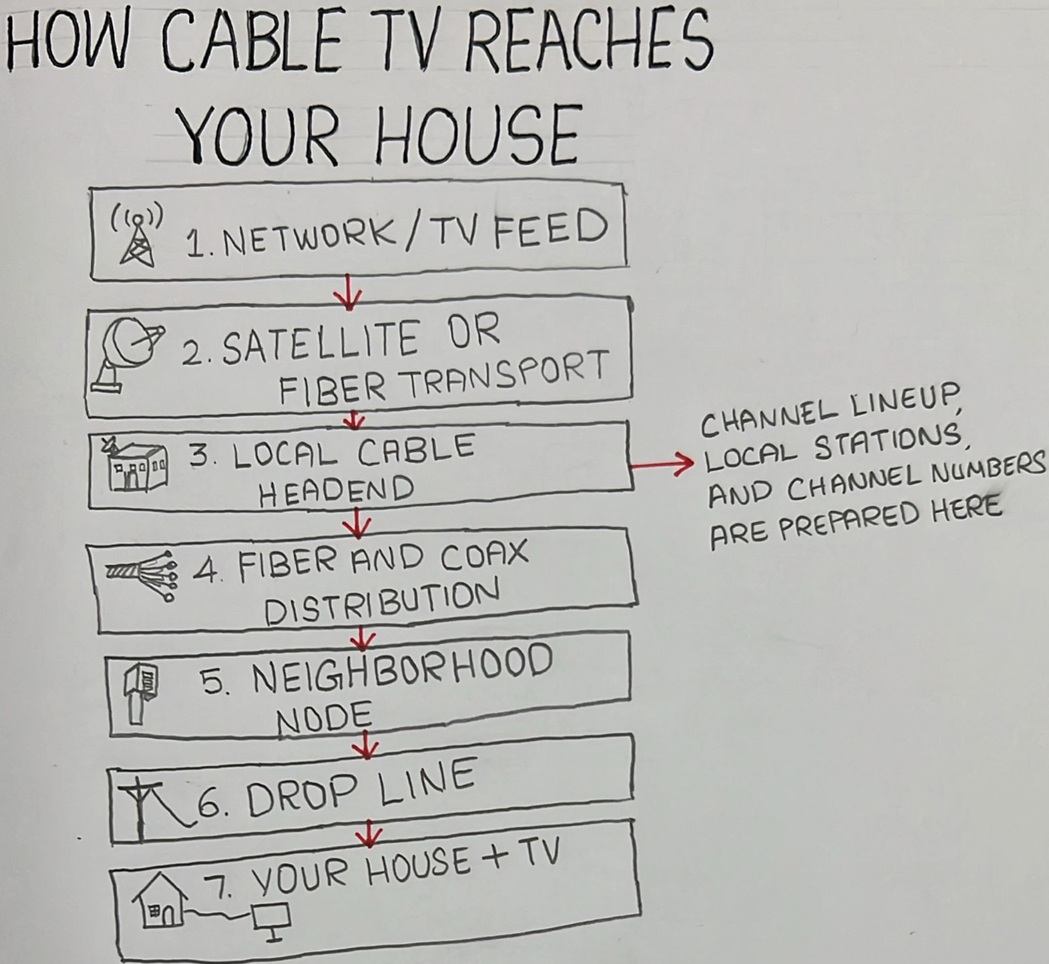
The exact path varies by provider and market. Some systems rely more heavily on fiber transport, some still use legacy coaxial distribution in the last mile, and some newer TV products are delivered more like managed streaming than traditional cable. This guide explains the general structure but does not describe every system in detail.
Quick Reference: The Cable Signal Path
| Stage | What happens there |
|---|---|
| 1. Network origination | ESPN, CNN, Discovery, and other networks produce and broadcast their feeds |
| 2. Cross-country transport | Feeds travel by satellite or fiber to cable provider regional facilities |
| 3. The headend | The local cable provider building that assembles the channel lineup for your market |
| 4. Regional distribution | Signals travel through fiber backbone to neighborhood nodes |
| 5. The node | A neighborhood-level point that converts the signal for local delivery |
| 6. The drop line | The cable that runs from a pole or underground line into your house |
| 7. Home equipment | The set-top box, modem, or gateway decodes the signal for your TV |
The Short Answer: a Managed Local Network
Cable TV is not a single nationwide pipe with channels flowing through it. It is a network of local managed systems, each operated by a cable provider for a specific service area. The national networks like ESPN or CNN are the same everywhere, but the wiring, the channel numbers, the local stations included, and the regional sports networks carried are all determined at the local level.
That is why two households on the same provider in different cities can have meaningfully different channel guides. The provider name is the same. The local system serving each address is different. Understanding the path that the signal takes makes those differences make sense.
Step 1: Programming Originates at the Networks
Every channel on cable starts somewhere as a programming feed. ESPN produces its content from its studios and broadcast operations centers. CNN runs its newsroom and assembles its programming. Discovery, Food Network, and other networks operate similarly. Local broadcast stations like the ABC, CBS, NBC, FOX, and PBS affiliates in each market produce their own news and broadcast network feeds.
These feeds are the raw material of cable TV. They exist independently of any cable provider. A network broadcasts its signal, and cable providers, satellite providers, and live TV streaming services all carry that same signal under licensing agreements called carriage deals. The same ESPN feed reaches Xfinity subscribers, Spectrum subscribers, DIRECTV subscribers, and Hulu Live subscribers. The network is one source. The delivery paths are many.
Step 2: Feeds Travel Cross-Country to Provider Systems
Network feeds reach cable provider systems through several possible transport paths. Some networks distribute their signal by satellite, which the cable provider receives at a satellite earth station and feeds into its terrestrial network. Some networks distribute through high-capacity fiber backbones operated by national telecom infrastructure. Major cable providers operate their own private fiber networks that move feeds between regional facilities.
The household watching ESPN in Cleveland is receiving the same content as the household watching ESPN in Phoenix, but the signal traveled different physical paths to get to each city. The end result on the TV looks identical. The infrastructure behind that result is regional and varied.
Step 3: The Cable Headend Prepares Your Local Lineup
The headend is the most important and least visible part of the cable infrastructure. It is a building, usually unmarked, operated by the cable provider in or near every metropolitan area it serves. The headend is where the magic of “your local cable lineup” actually happens.
At the headend, the cable provider receives the national network feeds, picks up the local broadcast station signals from local towers or fiber links, decides which channels appear in which packages, assigns the channel numbers used by households in that market, inserts emergency alert messaging required by federal regulation, and combines everything into the channel lineup that gets distributed to subscribers.
This is why channel numbers differ between cities even on the same provider. The headend in Cleveland decides that the local NBC affiliate is on channel 3. The headend in Phoenix decides that the local NBC affiliate is on channel 8. The decisions are made locally at each headend. Households in those cities never see the decision happen, but every channel they watch was assigned its number at a headend they have never visited.
Step 4: Distribution Through Fiber and Coax
From the headend, the signal travels through the cable provider’s local network toward neighborhoods. This network is usually a hybrid of fiber-optic cable for long distances and coaxial cable for the last few miles, though some newer systems are increasingly fiber all the way to the home.
The fiber portion carries the signal at high capacity over distances of miles. Fiber is preferred for the long runs because it loses less signal over distance and supports the bandwidth needed for hundreds of channels plus internet and phone service running on the same network. Coaxial cable, the thick copper-core wire most cable subscribers are familiar with, is still used for shorter runs closer to homes in many systems.
Step 5: The Neighborhood Node
Somewhere within a few blocks of most cable subscribers is a piece of equipment called a node. It is usually a metal box mounted on a utility pole or in a small underground vault. The node serves a defined neighborhood, typically a few hundred to a few thousand homes.
At the node, the fiber signal coming from the headend is converted to the coaxial signal that runs the last short distance to homes. The node is also the point where outages tend to localize. When everyone on the same block loses cable at the same time, the node serving that block is usually involved. When one household loses cable but the neighbors do not, the problem is usually closer to that one house.
Step 6: The Drop Line Into Your House
The final segment of the cable path is the drop line, which is the cable that runs from the node or a nearby distribution point into the individual house. The drop line is the part of the infrastructure that the household actually owns, in the sense that it physically enters the property.
Once inside the house, the drop line connects to a splitter that distributes the signal to each room with cable service. From there, the signal reaches the set-top box, modem, or gateway, which decodes it into the picture and channel guide the household actually sees.
Cable provider technicians who come to the house to fix service problems are usually working on this last segment. The headend and the long-distance infrastructure rarely require home visits. The drop line, the in-home wiring, and the equipment at the household end are where most repair calls land.
What Breaks Where When Channels Go Missing
Understanding the path helps diagnose problems by pattern.
- One specific channel is missing across the whole market: the issue is usually at the headend or upstream from it. A carriage dispute may have temporarily removed the channel. The channel may have been moved to a different tier. The package the household subscribes to may no longer include that channel.
- All channels are out in one home but the neighbors are fine: the issue is usually in the drop line, the in-home wiring, or the equipment. This is the most common type of outage and the kind that home repair calls usually fix.
- All channels are out for a whole block or neighborhood: the issue is usually at the node or in the local distribution serving that area. The cable provider’s outage map often shows these.
- Local channels are missing or look different from a previous market: the issue is the headend’s local broadcast carriage and the local channel map. Different headends carry different local affiliates.
- Channel numbers changed without any household action: the headend updated the local channel map. This sometimes happens after provider mergers, retransmission renegotiations, or system upgrades.
- The picture is intermittent or pixelated: the issue is usually in the drop line, the splitter, or the connection at the box. Signal quality problems at the household level rarely point to headend or distribution issues.
When calling the cable provider about a problem, the first question is usually “is this affecting just your house, your block, or the whole area.” That question is the provider’s way of localizing the issue along the infrastructure path. Knowing the path makes the question easier to answer.
The Short Version
Cable TV reaches the house through a long infrastructure chain: national networks produce programming, transport networks carry the feeds cross-country to regional cable provider facilities, the local headend assembles the channel lineup for the specific market, fiber and coaxial distribution moves the signal through the area, a neighborhood node converts the signal for local delivery, and a drop line brings it into the house, where home equipment decodes it for the TV.
Most of the differences households notice between cable markets, between providers in the same market, or between addresses on the same provider trace back to the headend stage. The national networks are the same everywhere. The local cable system that prepares the lineup is what makes one address’s cable experience different from another’s.
Leave a Reply