

One day a long-time cable subscriber notices something odd. The bill arrives with a new logo. The channel guide looks different. A few channels are gone. Some have moved to higher numbers. Saved guide preferences or recordings may also behave differently after an equipment or system migration. Same wires, same set-top box, same house, but the lineup feels foreign.
In many cases, this kind of change traces back to a corporate event, system migration, package update, or carriage renegotiation further up the chain. The customer experience often makes it feel like a routine “lineup update,” but the underlying cause is structural.
Understanding why this happens makes the changes less mysterious and helps subscribers know what to check when their channels suddenly look different.
Cable Mergers Do Not Just Change the Logo
The American cable industry has been through three decades of consolidation. Most subscribers today receive service from a company that did not exist in its current form twenty years ago. Charter Communications absorbed Time Warner Cable and Bright House Networks, then rebranded the combined service as Spectrum. Comcast acquired large portions of AT&T Broadband and assets from Adelphia, expanding into markets that originally belonged to those companies. Cablevision was acquired by Altice and rebranded as Optimum. Cox has remained largely independent through the same period, but most other regional operators have been absorbed into a smaller number of national providers.
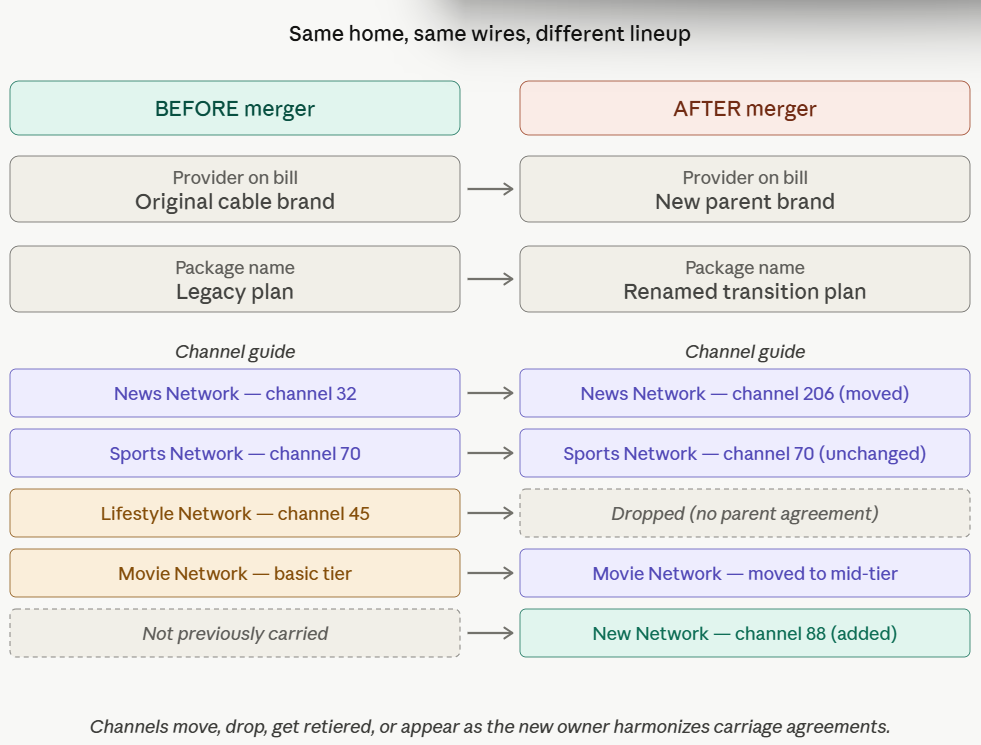
Each of these transactions reshapes more than just the brand on the bill. The new owner inherits the acquired company’s infrastructure, customer base, channel maps, package structures, and carriage agreements with networks. Over the months and years that follow, those layers gradually get harmonized to the parent company’s standards. That harmonization is what subscribers experience as channels moving, disappearing, getting renumbered, or shifting between tiers.
Why Channel Numbers Change After Mergers
When provider A acquires provider B, two channel maps suddenly need to coexist. The acquiring company has three options for handling them.
Leave the acquired company’s channel map in place. This preserves customer comfort because nothing changes from the subscriber’s perspective. The downside is that the parent company now operates with inconsistent channel maps across different markets, which complicates customer service, marketing, and technical support.
Force a renumbering to match the parent company’s existing map. This creates short-term frustration for acquired customers (who have to relearn where their channels live) but produces long-term consistency. It also typically generates a wave of customer service complaints in the months immediately after the change.
Partially harmonize. The most common approach. Some channels get renumbered to match the parent’s standard, others stay where they were, and over time the map drifts toward consistency without a single disruptive event. This is why subscribers in acquired markets often see channel numbers shift in waves over a period of months or years rather than all at once.
Why Some Channels Disappear or Move Tiers
Cable providers carry channels under negotiated agreements with the networks that own those channels. When a merger happens, the new owner inherits both companies’ carriage agreements, but those agreements are not always identical.
The acquired company may have carried a channel the parent company does not normally carry. After the merger, that channel may be dropped because the parent has no agreement with that network, or because the agreement the acquired company had cannot be extended on terms acceptable to the parent. Subscribers in those markets see the channel disappear without an obvious explanation.
The reverse also happens. The acquiring company may carry channels the acquired one did not, and after the merger, those channels start appearing in the acquired markets. New channels show up in the guide that the long-time customer never had access to before.
Tier placement can also change. A channel that was on the basic tier in the acquired company’s structure might end up on a mid-tier package under the parent’s structure, requiring an upgrade to keep watching it. This is one of the more frustrating types of merger-driven changes because it feels like a price increase without a service change.
Why Legacy Lineups Can Survive for Years
In smaller markets, the cost of harmonizing the acquired company’s channel map with the parent company’s standards may outweigh the benefit. The number of subscribers affected is small, the disruption from a renumbering is real, and the customer service overhead of explaining the change is significant. So the parent company sometimes leaves the acquired map in place indefinitely.
The result is that some markets continue to run on channel numbering schemes inherited from cable systems that were absorbed years or even decades earlier. A market technically branded as Spectrum or Optimum may still operate on a numbering scheme that originated with a small regional cable system long since dissolved into the parent company. The brand on the bill is current. The channel map underneath is historical.
This is one reason cross-market comparisons within the same provider are often inconsistent. Two Spectrum customers in different states can have noticeably different channel guides because their respective markets came from different predecessor systems and have not been fully harmonized.
Why Package Names Change After a Merger
Each cable provider has its own package architecture: tier names, channel groupings, pricing structure, and add-on options. When a merger happens, the acquired company’s customers are typically grandfathered into “legacy” packages that approximate their old plans.
Over time, the parent company usually phases out the legacy packages and migrates customers to its current tier menu. The migration may involve a renamed package with similar contents, or a recommended new tier that is not actually equivalent to the old one. Subscribers often experience this as a forced choice: either accept a new package (sometimes at a higher price) or lose access to channels they had been receiving.
This is also why long-time subscribers sometimes find that their package no longer exists when they try to renew or upgrade. The package they signed up for years ago has been retired, and the closest available option in the current menu has different channels, a different price, or both.
Why Provider Websites Sometimes Show Confusing Lineup Information
During and after a merger, provider websites often lag behind the actual state of the lineup. The company is updating its systems to reflect the new ownership, the harmonized channel maps, the renamed packages, and the migrated customers. Online lineup tools, FAQ pages, and customer service scripts can all be out of sync during this period.
The result is that a subscriber checking the official website may see a lineup that does not match what their actual cable box delivers, or what their bill describes. The most reliable source during these transition periods is the on-screen channel guide on the set-top box itself, which reflects what the home actually receives at that moment.
This is also why third-party channel lineup sites tend to be especially out of date in markets that have recently changed ownership. They often draw from older sources that have not been updated for the post-merger reality.
What to Check When Your Lineup Changes
When channels suddenly move, disappear, or shift tiers, the cause is not always a merger. A channel can change for many reasons, including ordinary carriage renegotiations between the provider and the network, system migrations as the provider upgrades infrastructure, package restructuring driven by competitive pressure, or carriage disputes that result in a channel being dropped temporarily.
A merger, system migration, carriage renegotiation, or package update can all explain sudden lineup changes. The following checklist helps narrow down what is happening:
- Did the provider brand on the bill change recently? A brand change typically means a merger or acquisition has occurred.
- Did the package name on the bill change? Renamed packages often signal a transition from a legacy plan to the current tier menu.
- Was there a notice in a recent bill or email about lineup updates? Providers often send bill inserts, emails, or account notices before major lineup changes, so recent provider messages are worth checking.
- Did a missing channel move to a higher number rather than disappear? The on-screen guide can confirm.
- Was the channel dropped because of a carriage dispute? These are usually publicly reported in trade press.
- Was the channel moved to a higher tier that requires an upgrade? The provider’s address-based lookup tool typically shows current tier placement.
- Is there an account-specific notice in the provider’s mobile app? Apps often show migration messages that the public website does not.
Across the lineup data reviewed for this project, a recent merger or system migration is a recurring explanation for confusing channel changes, but never the only one. Treating it as one possibility among several leads to a more accurate diagnosis than assuming any single cause.
The Short Version
Cable mergers reshape more than the brand on the bill. They cause channel numbers to shift, channels to appear or disappear, packages to get renamed or restructured, and lineup tools to lag behind reality. After a merger, lineup changes often roll out gradually rather than all at once, which is why subscribers in acquired markets sometimes see disruption that continues for months or years.
The complexity is not random. It is the predictable result of cable as a consolidation business. What feels like an arbitrary lineup change usually has a specific corporate or commercial reason behind it, and knowing the structure makes the experience less surprising and easier to navigate.
Sources and Further Reading
- FCC, Charter / Time Warner Cable / Bright House Networks Transaction — official FCC record of the 2016 transaction that produced today’s Spectrum brand
- Charter Communications, Completion of Time Warner Cable and Bright House Networks Transactions — Charter’s announcement of the merger close
- Comcast Corporation, Comcast Completes AT&T Broadband Transaction — Comcast’s record of acquiring AT&T Broadband
- Comcast Corporation, Time Warner and Comcast Complete Adelphia Communications Transactions — official record of how Adelphia’s assets were absorbed
- Altice, Cablevision and Suddenlink Form #4 US Cable Operator — Altice’s announcement of the Cablevision acquisition that became Optimum
- FCC, Cable Television Orders — index of cable industry transactions and FCC findings
Leave a Reply