

The pitch is familiar. Cancel cable, switch to a live TV streaming service, save money, get the same channels through an app. For some households this works exactly as advertised. For others, the move quietly removes content the household actually uses, replaces features that were taken for granted, or saves much less than the ads suggest.
The honest version of the comparison requires understanding what specific functions cable provides that streaming may or may not replicate, and which categories of viewer are well-served by switching versus which are not. The answer is not the same for every household, and it depends almost entirely on what the household actually watches.
The Two Questions That Matter
Two questions decide whether switching makes sense, in this order.
First, do live TV streaming services actually carry the channels the household watches, in the household’s specific market? This is a more specific question than “do they carry ESPN” or “do they carry NBC.” It includes the local affiliate of each network, the regional sports network for the household’s area, and any niche cable channels the household relies on. Generic answers are not enough.
Second, are the savings real once everything is accounted for? Most articles focus on the headline price difference between cable and streaming and stop there. The real comparison includes household internet costs, add-ons for missing channels, premium services, equipment differences, and the household’s actual use patterns. The gap is often smaller than it first appears.
Both questions need real answers before a decision. Most regret about switching to streaming comes from skipping the first question.
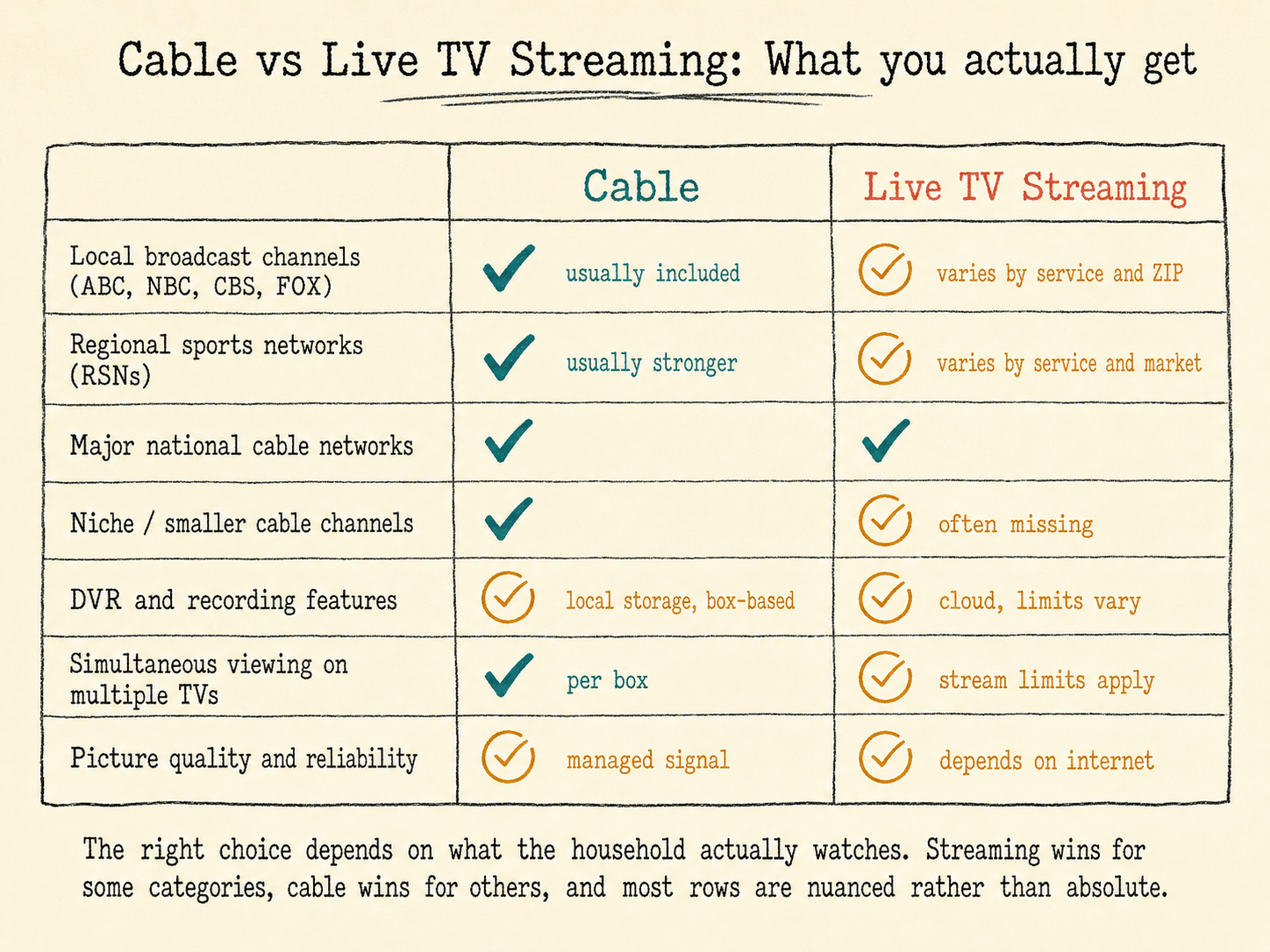
What Live TV Streaming Usually Replaces Well
Live TV streaming services have improved significantly over the past few years and now handle several categories of cable content well.
Major national cable networks are widely available across live TV streaming services, but the exact channel list still varies by service. Sports networks, major news channels, lifestyle networks, and the major entertainment networks generally appear on most major live TV streaming services. The channel count for these categories is generally comparable to mid-tier cable, though the specific composition differs.
National network programming on broadcast affiliates also works well. Network shows from ABC, CBS, NBC, and FOX, including primetime programming and major sports broadcasts, are typically available through whichever local affiliate the streaming service carries in the household’s market.
On-demand cable network content is generally accessible. Most streaming services include on-demand libraries from the cable networks they carry, similar to cable’s on-demand offerings.
Where Streaming Still Has Gaps
Several categories of cable content remain inconsistent or absent on live TV streaming services.
Niche cable networks (smaller specialty channels, hobbyist networks, less-distributed religious or international channels) often do not appear on major streaming services. Households that watch these channels frequently may not find them anywhere.
Regional sports networks are the most significant gap and the most common reason switches are regretted. Coverage varies dramatically by streaming service, RSN, and market. Sports fans need to verify the specific RSN carrying their team, not just the league or team itself.
Local broadcast affiliates outside the largest markets can also be inconsistent. Streaming services have expanded coverage significantly, but availability still depends on the specific service, the specific network, and the specific market.
Local Broadcast Channels
Cable providers usually carry the major local affiliates assigned to the household’s TV market. The household watches whichever NBC, CBS, ABC, FOX, and PBS affiliate is licensed for their region.
Major live TV streaming services carry many local affiliates in many markets, but availability still varies by service, network, and ZIP code. Some markets have full coverage of all four major broadcast networks across all major streaming services. Other markets have partial coverage. A few markets, particularly smaller ones, may be missing one or more affiliates on a particular streaming service.
The practical implication is that anyone considering a switch should verify, on the streaming service’s own site or signup tool, which specific local affiliates are available at their service address before subscribing. Generic “we carry NBC” claims are not sufficient. The question is which NBC affiliate, and whether it is available in the specific ZIP code.
Regional Sports Networks
Regional sports networks are the single biggest source of cord-cutting regret for sports-following households. Traditional cable providers are generally more likely than live TV streaming services to carry the local RSN for the area, but RSN availability still depends on provider agreements and market. Streaming services carry RSNs inconsistently, and the picture has been particularly fragmented in recent years.
Before switching, sports fans should verify the exact regional sports network, not just the league or team. A subscriber who follows their local MLB team needs to know which specific RSN broadcasts that team’s games (often a network owned by Diamond Sports Group, NBC Sports Regional Networks, or YES Network depending on the team), and whether that specific RSN is carried by the streaming service they are considering. Carriage can change season to season.
Some streaming services have RSN add-ons priced separately from the base package. Some have certain RSNs included by default. Some have no RSN coverage at all in certain markets. The household needs to verify the specific arrangement for their market and team before assuming streaming will replace cable’s sports coverage.
DVR, Simultaneous Streams, Internet Reliability, and Picture Quality
Beyond the channel question, cable and streaming differ in several practical features.
DVR. Cable’s DVR is typically a physical device with a fixed amount of local storage. Recordings are kept until the storage fills or the subscriber deletes them. Streaming services use cloud DVR with varying storage limits and retention periods, sometimes capped at a specific number of hours or a specific number of days. For households that record heavily, the DVR experience can be meaningfully different.
Simultaneous streams. Cable allows any number of TVs in a home to receive the signal simultaneously, limited only by the number of cable boxes the household rents. Live TV streaming services typically cap simultaneous streams between 2 and 6 per account. Households with multiple TVs and frequent simultaneous viewing may hit those caps.
Internet reliability. Cable TV signal travels over the same coaxial line as cable internet but uses a separate dedicated channel that does not depend on the household’s internet bandwidth. Streaming services depend entirely on home internet, both speed and reliability. A cable internet outage knocks out streaming TV. A weak or congested home Wi-Fi network can cause buffering even when the internet itself is fine.
Picture quality. Picture quality can vary. Cable uses a managed TV signal, while streaming depends on the streaming service, internet connection, device, and home Wi-Fi quality. Households with excellent internet and good streaming devices often see picture quality comparable to or better than cable. Households with marginal internet may see noticeably worse picture quality on streaming.
The Real Cost Comparison
Most cord-cutting articles compare a cable headline package price against a live TV streaming headline price and report the difference as the savings. The actual comparison is more complicated.
Cable bills include several charges beyond the headline package: equipment rental for each box, DVR fees, broadcast TV surcharges, regional sports surcharges, franchise fees, and taxes. The total monthly bill is meaningfully higher than the package price advertised.
Live TV streaming services have fewer hidden fees, though some still charge for additional simultaneous streams, premium add-ons, and regional sports add-ons. The comparison should be total monthly cost against total monthly cost, not headline against headline.
The savings are often smaller than the ads suggest once add-ons, internet costs, premium channels, sports access, and household viewing needs are included. Real savings exist for many households, but they shrink considerably for households that need add-ons to replicate what cable was already providing.
Who Should Switch
Several categories of household tend to do well with the switch from cable to live TV streaming.
- Households that watch primarily on-demand entertainment rather than live programming.
- Households whose live viewing is concentrated in widely-distributed national networks rather than regional or niche channels.
- Households without strong allegiance to a specific local sports team’s RSN.
- Households with reliable home internet and adequate Wi-Fi coverage.
- Households comfortable troubleshooting streaming devices, apps, and account-level issues.
- Single-person or couple households where simultaneous-stream limits are not a constraint.
Who Should Be Careful
Several categories of household are likely to find the switch frustrating or to discover that cable was providing more than they realized.
- Households that follow specific local sports teams, especially MLB, NBA, or NHL teams whose RSN may not be on the chosen streaming service.
- Households with weak or unreliable home internet, where streaming TV would suffer from buffering or outages.
- Households with multiple TVs that need to stream simultaneously, beyond the streaming service’s per-account limits.
- Households in smaller markets where local broadcast affiliate coverage on streaming may be incomplete.
- Households that record heavily and would feel a cloud DVR’s storage or retention limits.
- Households where someone in the home is uncomfortable with technology and finds traditional cable simpler to operate.
Checklist Before Canceling Cable
The following checks should happen before canceling cable, while service is still active to allow easy comparison.
- Make a list of the specific channels the household actually watches in a typical week, including local broadcast affiliates and the local regional sports network.
- Verify that each channel on the list is available on the streaming service being considered, at the household’s specific service address.
- For sports households, verify the specific RSN carrying the team they follow, not just the league or team name.
- Test home internet speed and reliability during peak evening hours when streaming TV would be most demanding.
- Count the number of simultaneous streams the household actually uses on a typical evening.
- Compare total monthly cost (cable advertised price plus all fees and equipment) against total monthly cost on the streaming service (base price plus needed add-ons), not headline-to-headline.
- Confirm the streaming service’s DVR limits match the household’s recording habits.
- Identify any premium channels the household uses and confirm whether they are included or available as add-ons on the chosen streaming service.
- If possible, test the streaming service during a free trial or one paid month before canceling cable, especially during the season for any sport the household follows.
Across the lineup data and subscriber pricing reviewed for this project, the most common cause of regret after switching is the household’s failure to verify regional sports network availability or specific local affiliate coverage before canceling cable. A few minutes of checking before the switch prevents most of the frustration that comes after.
The Short Version
The choice between cable and live TV streaming is real, but it is narrower and more household-specific than most articles suggest. Streaming covers most national cable networks well, handles broadcast network programming acceptably in most markets, and can save real money for households without significant local sports or local affiliate dependencies. It struggles with regional sports networks, niche cable channels, smaller-market local affiliates, simultaneous-viewing households, and homes with marginal internet.
The right decision depends almost entirely on what the household actually watches and how the household uses its TV. The decision should follow that, not the headline savings number.
Sources and Further Reading
- FCC, Cable Television — federal cable regulations and consumer disclosure rules
- FCC, Online Video Distribution — overview of how internet-delivered video services are treated under federal regulation
- S&P Global Market Intelligence, Kagan Media Research — industry reporting on live TV streaming subscriber trends and carriage economics
Leave a Reply