

The package selection page on a cable provider’s website is rarely a simple grid. There are usually four or five tier options with overlapping channel counts, three or four “premium” add-ons, regional sports surcharges, equipment fees, broadcast retransmission fees, and a promotional discount that disappears after twelve months. The total advertised price and the actual monthly bill are often quite different.
This complexity is not random. It is the result of decades of negotiation between cable providers and the networks they carry, layered on top of subscriber psychology and competitive positioning. Understanding how packages are actually structured makes the choice easier and reveals why the same channel can sit on different tiers across providers, why sports cost so much extra, and why the advertised package price is so often misleading.
Cable Packages Are Business Bundles, Not Clean Channel Categories
The first thing to understand is that cable packages are not designed primarily to organize channels logically. They are business bundles, structured to satisfy carriage agreements with networks, capture different segments of the customer base at different price points, and meet regulatory requirements around local broadcast carriage.
This explains a lot of the apparent contradictions in package design. Why does a sports network sit in the same package as lifestyle, news, and entertainment channels? Because cable packages combine many separate carriage agreements into one retail bundle. The provider is not building a perfectly themed channel category. It is assembling a package from the networks it has negotiated to carry at that price level, given each network’s own demands about tier placement and per-subscriber fees.
Once that frame is in place, the rest of the structure makes more sense.
The Usual Tier Structure
Most cable providers follow a similar layered structure, even when the marketing names differ. The layers, from bottom to top, typically look like this.
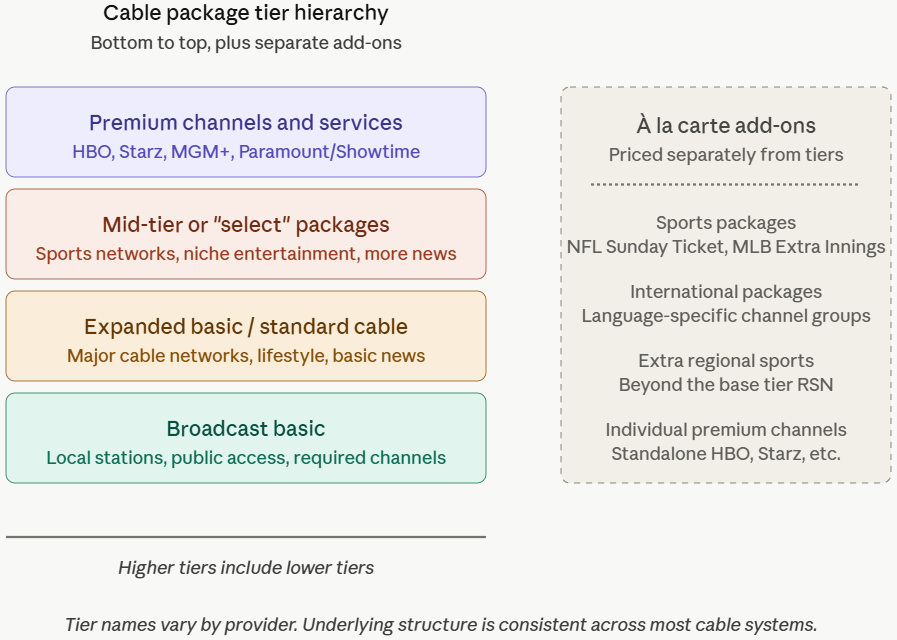
Broadcast basic. The lowest cable tier, commonly including local broadcast stations (ABC, CBS, NBC, FOX, PBS, and other locally-licensed networks), public access channels, and a small number of required local channels. This tier is sometimes called “lifeline” or “limited basic” depending on the provider.
Expanded basic or standard cable. Adds the major widely-distributed cable networks: lifestyle channels, food and home-improvement channels, basic news networks, and family entertainment. This is usually the tier that most casual cable subscribers buy.
Mid-tier or “select” packages. Adds more cable networks, often including most major sports networks, additional news channels, and niche entertainment. Many providers have rebranded this tier multiple times, but the structural position is consistent.
Premium channels and services. Premium options such as HBO, Starz, MGM+, and Paramount/Showtime-branded services usually sit above the base cable package as paid add-ons. They typically operate as standalone subscriptions on top of the base package, rather than as just another included tier.
À la carte add-ons. Additional packages priced separately: sports packages like NFL Sunday Ticket or MLB Extra Innings, international language packages, additional regional sports networks beyond what the base tier includes, and individual premium movie channels.
The exact tier names vary by provider and change frequently. Spectrum, Xfinity, Cox, and Optimum all use different marketing terms. The underlying layers, however, are remarkably consistent across providers.
Why Local and Basic Channels Are Separated
The separation of local broadcast channels into their own bottom tier is shaped by regulatory and licensing factors more than commercial ones. Local broadcast carriage is governed by a mix of federal carriage rules, retransmission agreements between cable providers and broadcasters, and market-specific provider arrangements. That is one reason local stations are usually handled differently from national cable networks.
This is also why broadcast basic is sometimes hard to find on a provider’s website. It is generally less profitable for the provider than the expanded tiers, and many providers offer it only when explicitly requested rather than promoting it as a default option. A subscriber who knows to ask can usually get it. A subscriber who does not will likely be steered to a higher tier.
Why Popular Cable Networks Sit in Mid-Tier Bundles
The most popular widely-distributed cable networks (ESPN, CNN, Fox News, USA, TBS, Discovery, HGTV) tend to sit in the mid-tier “expanded basic” or “select” package. This is the result of how their carriage agreements are written.
These networks demand wide carriage. They want to be available to as many subscribers as possible, both for advertising revenue (which depends on viewership) and for the per-subscriber fees they charge providers. In exchange for being placed in a widely-purchased tier, they accept that they will be bundled with networks they have no editorial connection to.
The networks that own popular sports rights (like ESPN, the regional sports networks, and the major sports-only channels) are usually the most expensive networks for cable providers to carry, in per-subscriber terms. This drives up the cost of any tier that includes them, which is why “select” tiers are typically priced significantly above expanded basic even when the channel count difference is modest.
Why Sports and Premium Channels Cost Extra
Sports rights are expensive. The leagues (NFL, NBA, MLB, NHL) and the networks holding their rights (regional sports networks, ESPN, the major broadcast networks) charge cable providers high per-subscriber fees because sports content drives a meaningful portion of cable’s value proposition. Cable subscribers who do not want sports do not want to pay for sports, and cable subscribers who do want sports are willing to pay extra for the most exclusive packages.
This is why most providers have a separate sports tier or surcharge that includes additional regional sports networks, college sports networks, and out-of-market sports packages. The base package might include ESPN and one local regional sports network, but additional regional networks, NFL RedZone, and out-of-market season packages cost extra.
Premium channels are structured differently. Services like HBO, Starz, MGM+, and Paramount/Showtime-branded options are owned by media companies that have historically preferred to operate as standalone premium subscriptions rather than being bundled into a tier. The premium price reflects both the production cost of original programming and the strategic positioning of these channels as a layer above standard cable.
Why the Same Channel Can Be on Different Tiers Across Providers
A network’s tier placement depends on the carriage agreement between that network and that specific provider. Two providers carrying the same channel can place it on different tiers because their negotiations produced different terms.
ESPN appears on Spectrum’s mid-tier “Select Signature” package but not on Spectrum’s lower-tier “TV Stream” package. On Xfinity, ESPN is included starting from a specific tier upward. On Cox or Optimum, the threshold may be different. The channel itself is the same in all cases. The bundle it gets included with is determined by what each provider negotiated.
This is one of the reasons cross-provider channel comparisons are difficult. “Provider A includes ESPN” and “Provider B includes ESPN” might both be true, but the price required to get ESPN on each can differ substantially depending on which tier the provider has placed it in.
The Hidden Cost Layer: Equipment, Broadcast Fees, RSN Fees, and Taxes
The advertised package price on a provider’s website is rarely the actual monthly bill. Cable bills include several additional charges that are typically broken out as separate line items rather than rolled into the headline price. The main categories include:
- Set-top box and equipment rental. Each cable box rents for a monthly fee, with multi-TV households paying separately for each box.
- DVR fees. DVR service is typically billed separately from the box rental.
- Broadcast retransmission fees. Cable providers pay local broadcast stations for the right to retransmit their signal, and these costs are passed through as a separate line item on the bill.
- Regional sports network surcharges. Where applicable, RSN fees are billed separately and can vary considerably by market.
- Franchise fees and taxes. Local franchise fees, state and federal communication taxes, and FCC regulatory fees add additional charges.
Exact fees vary by provider, market, package, and promotion, but the extra charges are often large enough to change the real monthly cost meaningfully. The safest comparison when shopping for cable is the estimated total monthly bill shown at checkout, not the headline package price.
How to Choose a Package Without Overpaying
The most common mistake is choosing a package based on channel count rather than on the specific channels watched. A 200-channel package and a 150-channel package can have nearly identical viewing value if the 50 extra channels are ones the household never turns on.
The practical approach is to identify the specific channels that matter, then find the lowest tier that includes all of them. Use the provider’s address-based lookup tool to confirm the tier placement of each channel for the specific household, since tier placement varies by provider and market.
Premium tiers are rarely worth the cost unless the household watches enough premium content to justify the markup. Most premium channels are also available as standalone streaming subscriptions for less than the cable add-on price, which is worth checking before adding them to a cable package.
Add-ons are negotiable, particularly during retention calls. Subscribers who threaten to cancel are routinely offered discounts on add-ons, fee waivers on equipment, or promotional rates on the base package. Across the lineup data and subscriber pricing reviewed for this project, the gap between the advertised package price and what a subscriber can negotiate is often substantial.
Quick Checklist Before Choosing a Package
- Which specific channels does the household actually watch? Make a short list.
- What is the lowest tier that includes all of those channels for the specific service address?
- Does the package include the local regional sports network needed in the household’s market?
- Are equipment fees, DVR fees, and broadcast TV fees included in the advertised price, or billed separately?
- When does any promotional rate expire, and what is the rate after the promotion?
- Are any of the desired premium channels cheaper as standalone streaming services?
The Short Version
Cable packages are business bundles shaped by carriage negotiations, not logical channel groupings. The tier structure (broadcast basic, expanded basic, mid-tier, premium, à la carte add-ons) is consistent across providers even when the marketing names change. The same channel can appear on different tiers across providers because each provider negotiates its own carriage deal. The advertised package price is rarely the full bill; equipment, broadcast fees, RSN surcharges, and taxes add a meaningful amount on top.
The complexity is not random. It is the predictable result of how cable as a business has been structured. Knowing the structure makes the choice between packages, providers, and alternatives a lot more manageable.
Sources and Further Reading
- FCC, Cable Television — overview of cable service rules, carriage, and consumer protections
- FCC, Retransmission Consent and Must-Carry Rules — how local broadcast carriage works
- NCTA, NCTA – The Internet & Television Association — industry resources on cable structure
Leave a Reply