

Deciding to cancel cable is the easy part. The actual cancellation involves a phone call, a retention pitch, an early termination fee question, equipment returns, a final bill, and sometimes a refund that takes weeks to arrive. Households that walk in expecting a quick five-minute call are often surprised by how many steps the process involves and how many places it can go wrong.
This guide walks through the cancellation sequence in the order it usually happens, with the specific questions to ask and the documentation to keep at each step. The goal is to leave the cable provider cleanly, without ongoing charges, equipment fees, or surprise items on the final bill.
Cable cancellation procedures, early termination fees, equipment return policies, and refund timelines vary by provider, market, and contract. This guide explains the general structure, but the specific terms applicable to any household should be verified directly with the provider before canceling.
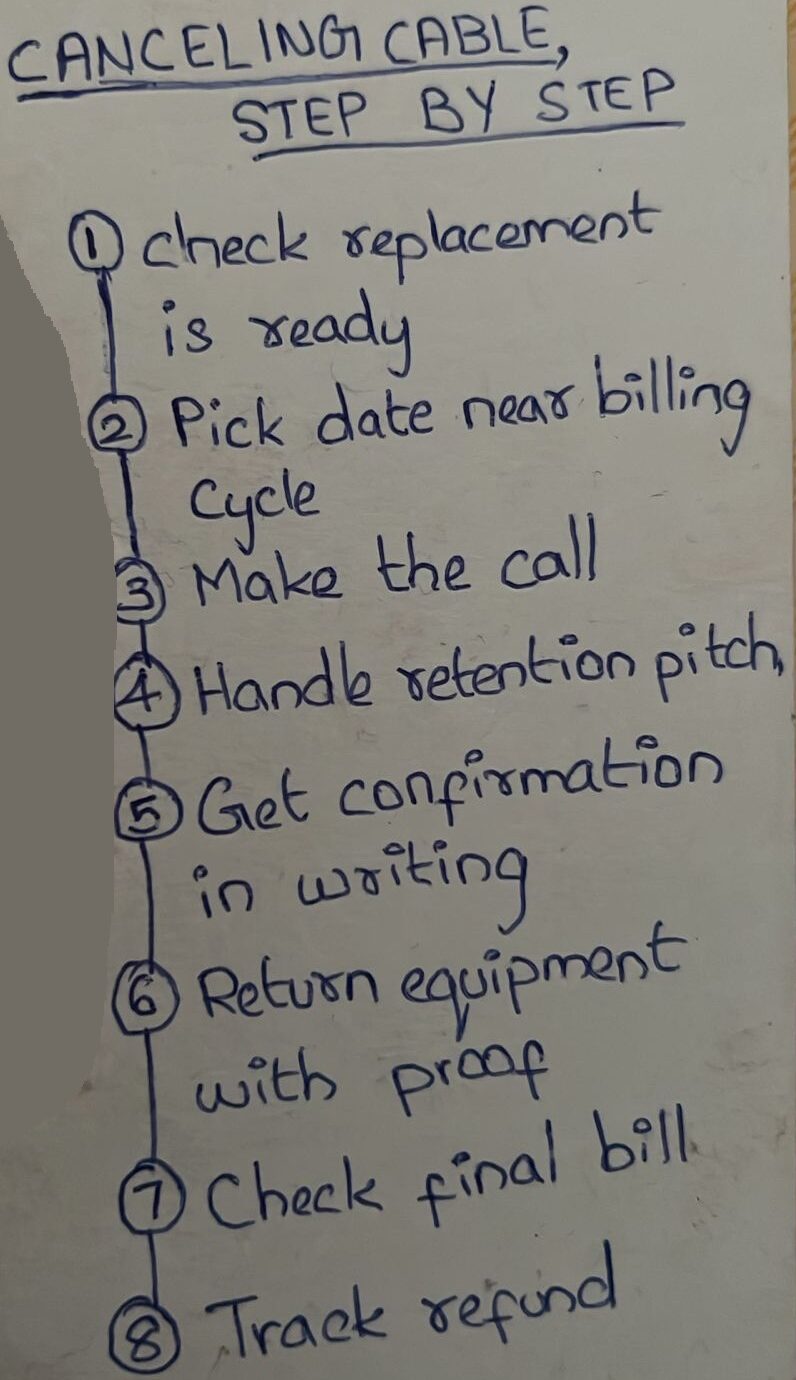
Quick Reference: The Cancellation Sequence
| Step | What it covers |
|---|---|
| 1. Confirm replacement is ready | Antenna, streaming service, or internet-only plan working before you call |
| 2. Pick a cancellation date | Time the cancellation around the billing cycle to avoid overpaying |
| 3. Make the cancellation call | Expect a retention pitch and be prepared with a specific date |
| 4. Handle bundle and ETF questions | Early termination fees, bundle discount changes on remaining services |
| 5. Get confirmation in writing | A confirmation number or email is the household’s best protection if billing continues |
| 6. Return equipment with proof | Every box, modem, and remote returned with a receipt or tracking number |
| 7. Check the final bill | Pro-rated charges, lingering equipment fees, refund credits |
| 8. Track refunds or credits | Refunds for prepaid days can take weeks to process |
Step 1: Confirm Your Replacement Is Ready Before You Call
The most common mistake households make when canceling cable is canceling first and then figuring out the replacement. The result is often a stretch of days with no TV service at all, while waiting for an antenna to arrive, a streaming subscription to activate, or an internet-only plan to take effect.
Before making the cancellation call, the replacement setup should already be working. For households switching to streaming, that means the live TV streaming service is signed up for and tested, the streaming devices are connected and configured, and the household has confirmed that the channels they care about are accessible. For households switching to an antenna, that means the antenna is installed and the local channels are scanning in cleanly. For households keeping internet but canceling TV, that means the new internet-only price has been confirmed in advance.
The cable service can remain active during the setup of the replacement. Canceling early to “force” the switch usually creates a service gap that has no upside.
Step 2: Pick a Cancellation Date Around the Billing Cycle
Cable bills run on a billing cycle, usually monthly. The cancellation date matters because some providers pro-rate the final month and some do not.
For providers that pro-rate, canceling mid-month means the final bill charges only for the days of service used. For providers that do not pro-rate, canceling mid-month often means paying for the full month anyway, with no refund for unused days. The household should ask the provider directly which approach applies before picking a date.
If the provider does not pro-rate, canceling on or near the last day of the billing cycle captures the most value from the final month. If the provider does pro-rate, the date matters less, though planning the call a few days before the billing cycle ends still leaves a buffer for any administrative delays.
Step 3: Make the Cancellation Call and Expect a Retention Pitch
Cable cancellations are usually handled by phone, sometimes through a retention department specifically. Some providers may also accept cancellation through an online account portal, chat, an in-person store visit, or a written request, but phone cancellation remains the most common path. The call typically follows a predictable pattern.
After the household states the intent to cancel, the representative often offers a retention deal: a temporary discount, a free month, a package downgrade at the current price, or an equipment fee waiver. These offers can be genuinely good if the household was on the fence about leaving. They can also be tempting reasons to stay with service that was no longer worth keeping.
The clearest position to walk in with is a decided one. Households that have already chosen to leave should be polite but firm. Households still weighing the decision can listen to the offer and decide. Retention agents may have access to offers that regular customer service agents do not, but the exact options vary by provider and account, and each round of asking takes time without guaranteeing a better result.
Specific things to confirm on the call:
- The exact cancellation date
- Whether the final month will be pro-rated
- What equipment must be returned and by when
- Whether any early termination fee applies
- What happens to the bundle discount if internet service is being kept
Step 4: Ask About Early Termination Fees and Bundle Changes
Two questions deserve specific attention during the call.
The first is whether an early termination fee applies. Households that signed a multi-year contract may owe a fee if canceling before the term ends. The amount usually declines over the course of the contract. The fee is not always volunteered by the representative, so the household should ask directly. Some providers waive early termination fees in specific circumstances, including documented moves outside the service area, but the waiver is not automatic and has to be requested.
The second is whether the bundle discount on remaining services will be affected. Households on a bundled cable-and-internet plan often see the internet portion of the bill rise after canceling cable, because the standalone internet price is higher than the bundled price. Before the cancellation call, the household should know what the standalone internet price will be after the bundle is broken. If the new internet price is unacceptable, this is the moment to negotiate or reconsider, not after the cable cancellation is already processed.
Step 5: Get Confirmation in Writing
The single most important documentation step is getting confirmation that the cancellation was processed.
Phone calls alone are not always enough. Cable providers occasionally have records showing that a cancellation request never went through, that the date was different from what the household understood, or that the cancellation applied to the wrong service. Without written confirmation, the household has fewer options if billing continues after the supposed cancellation date.
Ask the representative for a confirmation number at minimum. Better yet, ask for a follow-up email or written confirmation that includes the cancellation date, the equipment that must be returned, any fees that apply, and any retention offers accepted. Some providers send this automatically. Others require it to be requested. If the representative cannot send written confirmation, note the confirmation number, the date and time of the call, and the representative’s name. These details may be needed later if a billing dispute arises.
Step 6: Return Equipment with Proof
Cable equipment usually has a return window, often two to four weeks from the cancellation date. Equipment not returned within the window generates fees that continue to bill on the closed account.
Most providers accept equipment returns through one of two paths. Returns at a company-owned store generate an in-person receipt listing each device returned. Returns by mail use a prepaid shipping label, often available through the provider’s website or sent in the cancellation confirmation email.
Whichever path is used, the household should keep proof of return for every device:
- Set-top boxes, one per TV that had cable service
- DVRs, separately from set-top boxes if applicable
- Modems, gateways, or other internet hardware if also canceling internet
- Remote controls, power cords, and any accessories listed on the cancellation paperwork
For mail returns, the tracking number is the proof. For in-store returns, the printed receipt is the proof. In either case, keep the documentation for at least six months after the cancellation date. Equipment-related billing disputes can surface weeks or months after the fact, and the proof of return is what resolves them.
Step 7: Check the Final Bill Carefully
The final cable bill arrives one to two billing cycles after the cancellation date. It should reflect the cancellation correctly, but errors are common enough that the bill needs a careful read.
Specific items to verify:
- The cancellation date matches what was agreed on the call
- Charges for service after the cancellation date should not appear
- Equipment fees should not appear if the equipment was returned within the window
- Any early termination fee charged matches what was discussed on the call
- Any agreed retention adjustments are reflected
- Pro-rated credits for unused days appear if the provider pro-rates
If anything on the final bill does not match the cancellation agreement, call the provider with the confirmation number in hand and dispute the specific item. The earlier in the billing cycle this happens, the easier the correction usually is.
Step 8: Track Refunds or Credits if You Prepaid
Households that prepaid for service or that paid the final bill in full before the pro-rated credit was applied may be owed a refund.
Refund processing can take longer than the household expects. Some providers issue refunds within two to four weeks. Others take six to eight weeks or longer. The refund is usually sent as a check by mail or as a credit back to the original payment method.
If the refund has not arrived within a reasonable window, the household should call and ask about the status. Refund requests sometimes get lost in the post-cancellation administrative process, and a direct call often surfaces the issue. The confirmation number from the original cancellation call helps the representative locate the account quickly.
Common Surprises After Canceling Cable
A few patterns appear often enough in post-cancellation experience to be worth knowing in advance.
- Continued billing after the cancellation date, due to administrative delays or processing errors. Usually resolvable with a call and the confirmation number.
- Equipment return fees applied even after the equipment was returned, due to delayed inventory updates at the provider. The return receipt or tracking number is the resolution.
- A new bill arriving from a different department within the same provider for services that were not actually canceled, such as internet remaining active when the household thought everything was canceled.
- The bundle discount disappearing on remaining services, raising the internet bill or phone bill that was kept.
- A retention follow-up call weeks after the cancellation, offering a discount to return. These calls are sometimes worth listening to but are not obligations.
- Final account statements continuing to arrive for several months after the cancellation, even when the balance is zero, until the provider’s system fully closes the account.
Most of these are resolvable with a phone call and the documentation kept from the cancellation process. The household that keeps the confirmation number, the equipment return receipts, and the final bill has the proof needed to dispute any post-cancellation charges that appear in error.
The Short Version
Canceling cable is a multi-step process, not a single phone call. The sequence is to confirm the replacement is working, time the cancellation around the billing cycle, make the call and handle the retention pitch, ask about early termination fees and bundle effects, get confirmation in writing, return all equipment with proof, check the final bill carefully, and track any refund owed.
The household that handles each step deliberately usually leaves the provider cleanly, without ongoing charges or disputes. The household that treats cancellation as a quick phone call often finds itself dealing with billing errors, equipment fees, or unexpected internet bill increases for weeks afterward. The decision to cancel is the easy part. The execution is what determines whether the cancellation actually saves money.
Leave a Reply