

Cable service does not move with the household the way other utilities do. Electricity at the new address is electricity. Cable at the new address may be a different provider, a different channel lineup, a different price structure, or no cable at all. Some moves involve a smooth transfer of service. Others involve canceling the current plan, paying an early termination fee, and starting over with a new contract. The difference depends on where the household is moving and what the current contract requires.
This guide walks through what actually happens to cable service during a move, the decisions that come with it, and the specific questions to ask the provider before the move date rather than after.
Cable contracts, early termination fees, transfer policies, and channel lineups vary by provider, market, and contract length. This guide explains the general structure, but the specific terms applicable to any household should be verified directly with the provider before the move.
Quick Reference: What Happens by Move Scenario
| Move scenario | What usually happens |
|---|---|
| Same market, same provider | Usually the smoothest transfer, but confirm plan, equipment, price, and lineup at the new address |
| Different market, same provider | Service transfers, but plan structure and lineup may change |
| Different market, new provider required | Current service cancels, new contract and new lineup at the new address |
| Long-distance move outside provider footprint | Cancellation may qualify for an early termination fee waiver — ask directly |
The Three Move Scenarios
Most cable moves fall into one of three categories. The category determines almost everything else about how the move will affect the household’s service.
The first scenario is a move within the same market, served by the same provider. This is the cleanest case. The provider transfers the service to the new address, usually with the same plan, the same channel lineup, and the same price. Equipment moves with the household. Service continues with minimal interruption.
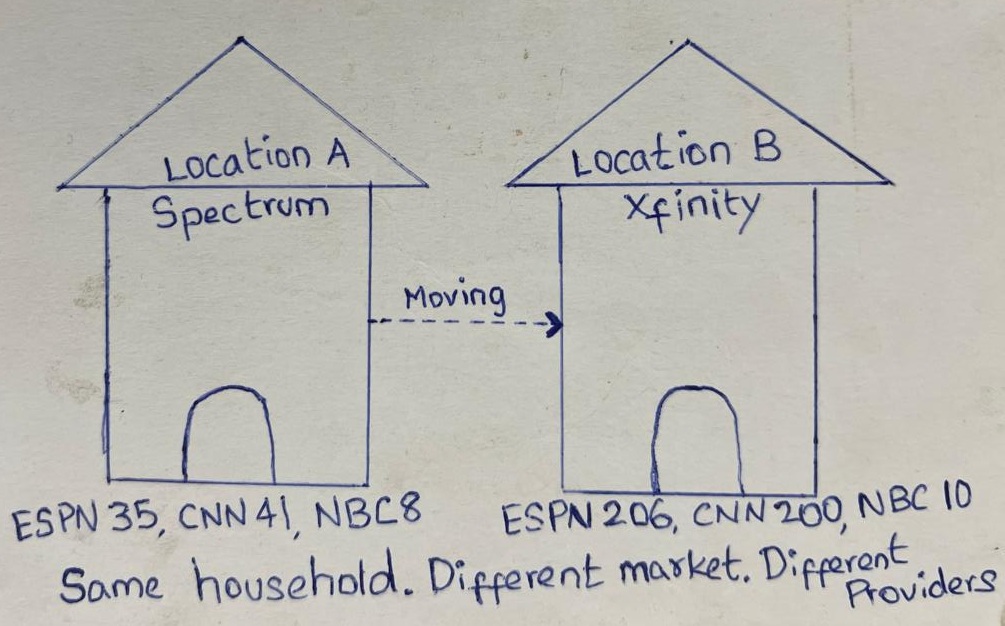
The second scenario is a move to a different market where the household’s current provider also operates. This is partially clean. The provider can usually open service at the new address, but the specific plan, channel lineup, and price may all be different. Local broadcast affiliates change. Regional sports networks change. The package the household subscribed to may not exist in the new market, or may include different channels at a different price point.
The third scenario is a move to a market where the household’s current provider does not operate. This is a hard reset. The current service must be canceled, the household chooses a new provider at the new address, signs up as a new customer, and starts a new contract with a new lineup, new pricing, and new equipment.
What Actually Transfers
The word “transfer” makes a cable move sound seamless. In practice, what transfers depends on the move scenario and the provider’s policies.
Account history and credit standing with the provider generally transfer. This is useful for retention pricing and for avoiding new-customer deposits at the new address. Equipment usually transfers physically for in-footprint moves, though some long-distance same-provider moves ask the household to return old equipment and receive new equipment at the destination.
Plans and pricing do not always transfer. The household’s current package may not be offered in the new market, or may be priced differently. Promotional credits often do not survive the move. Bundle discounts may not apply at the new address if the bundle structure is different there.
Service start at the new address is sometimes immediate and sometimes requires a technician visit. Households should not assume cable will be active at move-in unless this has been confirmed with the provider in advance.
The Channel Lineup Changes
The most overlooked part of a cable move is that the channel lineup at the new address frequently changes, especially when the move crosses a provider market or local affiliate boundary.
Local broadcast affiliates change with every market move. The NBC, CBS, ABC, FOX, and PBS stations carried at the new address belong to that market’s affiliate group, not the old one. For households used to specific local news anchors or specific local programming, this is a noticeable shift even when the network logos look familiar.
Regional sports networks change too, and this is usually the change with the largest impact. A household that followed a specific team through the local RSN at the old address may find that the new market does not carry the same RSN, or carries a different team’s network entirely. Sports fans should verify RSN availability for the new address before assuming the move will not affect game access.
National cable networks like ESPN, CNN, and the major entertainment channels generally appear in every market, but the specific channel numbers usually change, and the tier they fall into may also differ.
The Contract and Early Termination Fee Question
Cable contracts often include early termination fees that apply if service is canceled before the contract term ends. The amount typically declines over the course of the contract but can still be meaningful in the first year of a multi-year agreement.
For moves within the same market or to a same-provider market, the early termination fee usually does not apply. Transferring service to a new address is not the same as canceling service.
For moves outside the provider’s service area, early termination fees depend on the contract and provider policy. Some providers waive the fee for a documented move outside their footprint. The household should ask directly before assuming the fee will or will not be charged, and have documentation of the new address ready when asking.
Equipment: What to Return and What Travels
Set-top boxes, DVRs, modems, and gateways are usually rented from the provider. What happens to them on a move depends on the scenario.
For same-market and same-provider moves, equipment typically travels with the household and is reactivated at the new address. For different-provider moves, all rented equipment must be returned. Most providers accept returns in person at company stores, or by mail with a prepaid label.
Unreturned equipment generates fees that continue to bill on the closed account, sometimes for months after the service was canceled, until either the equipment is returned or the fees are written off. Households moving to a new provider should retain proof of return for every device.
Owned equipment, such as a purchased modem, belongs to the household and travels regardless of provider change. A modem that worked on the old provider’s network may or may not be compatible with the new provider’s network. Check the new provider’s approved equipment list before assuming compatibility.
Moving as a Cord-Cutting Decision Point
A move is one of the natural moments to reconsider whether cable service is still the right choice for the household. The contract is being renegotiated, the lineup is changing, and the equipment situation is in flux. None of those things are true during a normal renewal cycle.
Three questions are worth asking at the move:
- Has the household’s actual cable use decreased to the point where streaming would cover what it watches?
- Does the new market’s lineup still include the channels the household actually watches, or is access to specific local or regional content changing?
- Is the household’s preferred provider even available at the new address, and if so, on what terms?
If the answers point toward cord-cutting, the move is a clean moment to switch. The cancellation paperwork is already happening. The equipment is already being returned. The household has not yet signed a new contract at the new address. Starting fresh with internet-only service is structurally easier here than at any other time.
For households that decide to keep cable, the move is still a useful moment to renegotiate. New-customer pricing at the new address may be better than transfer pricing on a continued plan, but the household should compare both options before accepting the move offer.
Pre-Move Checklist
A few specific items to handle before the move date.
- Confirm whether the current provider operates at the new address. The provider’s website usually has an availability lookup by ZIP code or street address.
- Identify any early termination fee that would apply if the move forces a cancellation, and ask about a move-related waiver if the new address is outside the provider’s footprint.
- Check the channel lineup at the new address. If the household follows a specific RSN or specific local programming, this matters.
- Compare the price of transferring service versus signing up as a new customer at the new address. New-customer promotional pricing is often better than transfer pricing, even with the same provider.
- Schedule the cable activation at the new address for the move-in date or shortly after, accounting for any technician visit requirements.
- Arrange to return any equipment that will not travel with the household, with proof of return retained.
- If switching providers, schedule both the cancellation of the old service and the activation of the new service so there is no overlap and no gap.
Common Surprises Worth Asking About
A few patterns appear often enough in cable moves to be worth a direct question to the provider.
- The new address showing as not serviceable when it actually is, due to an out-of-date service map that can be resolved by calling.
- The new market’s package pricing being substantially different from the old market’s, even for what looks like the same channel tier.
- Equipment return windows being shorter than expected, with fees applied if returns arrive late.
- Promotional credits dropping off entirely at the move, even when the household assumed they would carry over.
- The contract term resetting at the new address on a transfer, locking the household into a new commitment period rather than continuing the existing one.
- RSN access at the new address differing from what the provider’s website appears to show, often because the website defaults to a national lineup rather than the market-specific one.
All of these are addressable by asking directly during the move setup call. The provider’s representatives have access to market-specific information that is sometimes not surfaced on the public website.
The Short Version
Cable service is tied to address, not to the household. Moving means making decisions about whether to transfer, whether to switch providers, whether to use the move as a cord-cutting moment, and whether the new market’s lineup still serves the household’s actual viewing. None of these are automatic. All of them benefit from being thought through before the move date.
The cleanest move sequence is to check provider availability at the new address, confirm what would and would not transfer, check the new lineup against what the household actually watches, ask about move-related fee waivers and promotional pricing, and schedule the equipment and activation logistics in advance. The household that handles all of this before the move usually pays less and gets better service than the household that figures it out after.
Leave a Reply