

Two homes in the same state can turn on the local NBC channel and see entirely different local news. One sees a New York anchor reading the morning headlines from a New York studio. The other, less than two hours away, sees a Philadelphia anchor in a Philadelphia studio. The network programming that follows the news is the same. The local content around it is not.
This is one of the more disorienting parts of moving across the country, or even across a state line. The “NBC channel” is not a single thing. It is a national network that distributes its programming through roughly 200 different local stations, each one licensed to serve a specific area. Which station you receive depends on where you live.
The reason is rooted in how broadcast television was structured decades before cable existed, and that structure still determines what shows up on the local channels of a cable lineup today.
Networks License Their Programming to Local Affiliates
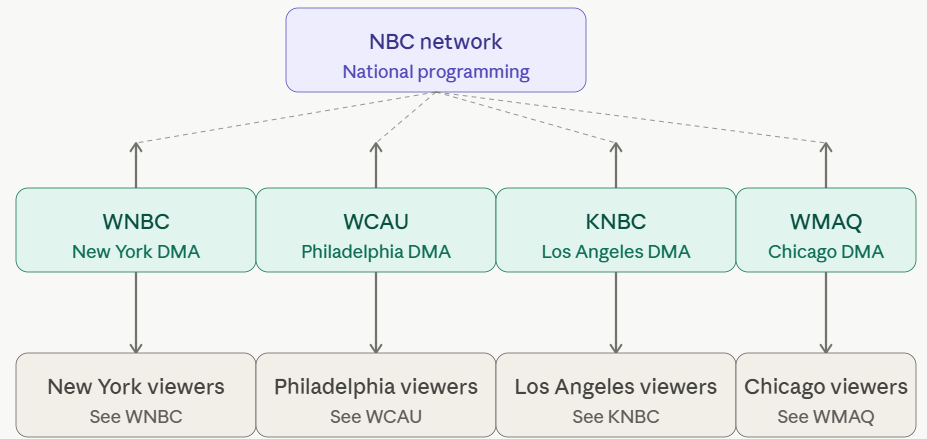
NBC, CBS, ABC, FOX, and PBS are national networks. They produce or acquire programming and distribute it across the country. They do not, however, own a transmitter in every city. Instead, they have agreements with local stations called affiliates, who hold the rights to broadcast that network’s programming in a specific geographic area.
There are roughly 200 NBC affiliates across the United States, and similar numbers for CBS, ABC, and FOX. Each affiliate airs the network’s national programming during designated hours, including primetime shows, morning shows, and major sports events. Outside those hours, the local affiliate fills the schedule with its own content: local news, local sports coverage, syndicated reruns, and infomercials in the early morning hours.
Each affiliate has its own call sign. The NBC affiliate in New York is WNBC. In Philadelphia, it is WCAU. In Los Angeles, it is KNBC. In Chicago, it is WMAQ. Same network. Different stations. Different local newsrooms. Different weather forecasts. Different sports coverage.
What a Designated Market Area Actually Is
The geographic boundaries that determine which affiliate serves which household are called Designated Market Areas, or DMAs. The system was created by Nielsen, the television ratings company, to define the geographic areas that broadcast stations effectively reach.
There are around 210 DMAs covering the entire United States. Each DMA has its own set of local affiliates for the major networks. Move from one DMA to another and the affiliates change. The NBC programming is the same in both places, but the station broadcasting it, the local news around it, and the on-air talent reading it are all different.
DMAs do not follow state lines. The New York DMA includes parts of New Jersey, Connecticut, and Pennsylvania. The Washington DC DMA spans parts of Virginia, Maryland, and West Virginia. Large states such as Texas contain many different DMAs because no single local station market covers the whole state.
This is why ZIP code matters more than state when it comes to local channels. Two homes in the same state can sit in different DMAs and receive different local affiliates. Two homes in different states can sit in the same DMA and receive the same affiliates. The political boundaries are not what determine the lineup.
Owned-and-Operated Stations Versus Independent Affiliates
In the largest markets, the networks themselves often own the local station directly. These are called owned-and-operated stations, or O&Os. WNBC in New York, KNBC in Los Angeles, WCAU in Philadelphia, and WMAQ in Chicago are all owned by NBCUniversal directly, rather than being independent affiliates with separate ownership.
In smaller markets, the local affiliate is typically owned by a separate broadcasting company that has an affiliation agreement with the network. Companies like Hearst Television, Sinclair Broadcast Group, Tegna, and Gray Television own dozens of local affiliates each, scattered across markets large and small.
The practical difference for viewers is mostly invisible during network programming hours. The bigger differences show up in local news, where ownership influences editorial priorities, investment in local newsrooms, and what counts as a major story. Two NBC affiliates with different owners can have noticeably different local news coverage even when airing the same NBC national programming.
How This Affects What You See on Cable
Cable providers carry the local broadcast stations assigned to the market they serve, based on a mix of TV market boundaries, federal carriage rules, retransmission agreements, and provider-specific arrangements. The cable system delivering service to a Houston home cannot substitute the WNBC feed from New York for KPRC, the local NBC affiliate for the Houston DMA. WNBC is a New York-market NBC station, not the local NBC affiliate for Houston.
This is why “what channel is NBC on Xfinity” has no universal answer. Xfinity carries WNBC for subscribers in the New York DMA. It carries KPRC for subscribers in the Houston DMA. Both are “NBC” on the channel guide, but they are different stations on different channel numbers, with different local content.
The same logic applies across all the major networks. The CBS affiliate in your area is whichever station holds the CBS license for your DMA. Same for ABC, FOX, PBS, and the smaller networks like The CW and MyNetworkTV.
Why Local Stations Matter Beyond Network Programming
If local affiliates simply rebroadcast the national network feed, the differences between them would not matter much. But local affiliates produce significant amounts of their own content, and this is where the practical differences show up.
Local news is the most obvious example. Morning news, midday news, evening news, late news, weather forecasts, traffic reports, and breaking local stories all come from the local affiliate, not the national network. Move from one DMA to another and the entire local news ecosystem changes. The anchors are different. The weather forecast is for a different region. The local sports coverage focuses on different teams.
Local affiliates also handle emergency broadcasts, severe weather alerts, and AMBER alerts for their specific market. The station that interrupts programming for a tornado warning in Oklahoma is not the same station that interrupts for a hurricane warning in Florida. Both might be CBS affiliates, but they serve different communities and different emergency systems.
Syndicated programming during non-network hours also varies by station. The morning talk show, the afternoon court show, the evening game show — these are bought by the local affiliate from syndication companies and can differ from one affiliate to another even within the same network.
Why ZIP Code Is the Right Question to Ask
Cable provider lookup tools and channel guides ask for a service address or ZIP code because that is the most reliable way to determine which DMA a household is in, and therefore which local affiliates apply.
Nielsen defines DMA regions using counties and ZIP codes, and those market boundaries are one reason provider lookup tools need a ZIP code or service address. A ZIP code in suburban New Jersey might be in the New York DMA or the Philadelphia DMA depending on its specific location, and that determines whether the household receives WNBC or WCAU as its NBC affiliate.
Generic “what channel is NBC” articles online cannot answer this without a ZIP code, because the answer literally depends on which DMA the household sits in. Across address-specific lineup data reviewed for this project, local broadcast channels are the single biggest reason two cable lineups in the same state can look different.
The Short Version
National networks like NBC, CBS, ABC, and FOX distribute their programming through hundreds of local affiliates, each one licensed to serve a specific Designated Market Area. The boundaries of those market areas are based on broadcast viewing patterns, not state lines, which is why ZIP code determines which affiliate appears on a household’s cable lineup.
Two homes in the same state can sit in different DMAs and watch different local stations even when both are tuned to “NBC.” The network is the same. The station is not. And the local news, weather, sports, and emergency broadcasts that flow through that station are tied to the geography of broadcast television, not to the geography most people carry in their heads.
Sources and Further Reading
- Nielsen, DMA Regions — overview of how Designated Market Areas are defined
- NBCUniversal, NBC Owned Television Stations — list of NBC owned-and-operated stations
- FCC, Television Broadcast Station Search — official station database
Leave a Reply