

A cable subscriber opens their monthly bill. The headline package price is reasonable. Then the line items appear: a “Regional Sports Network fee,” a “Broadcast TV fee,” equipment rental for each box, DVR service, franchise fees, and taxes. The total bill is significantly higher than the package price advertised when they signed up.
A meaningful portion of that gap is sports. Even for households that rarely watch live sports, sports networks are typically bundled into the package, and surcharges for regional sports coverage often appear as separate line items. Sports drives the cost of cable in ways that affect almost every subscriber, not just the ones tuning in to live games.
Understanding why this happens clarifies a lot about cable pricing and helps explain why the same household paying a similar package price five years ago now pays noticeably more.
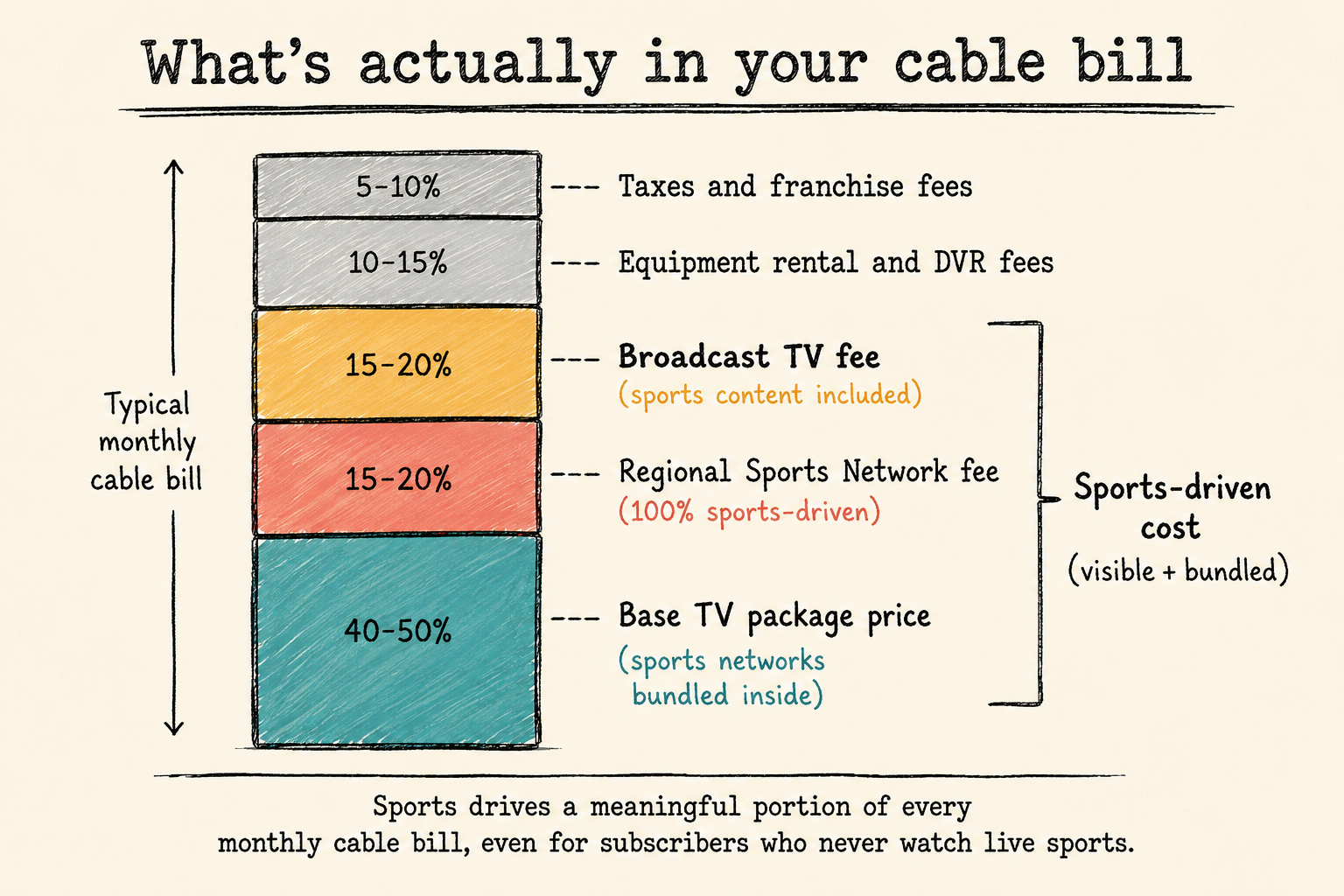
Industry reporting suggests that for a typical mid-tier cable bill, the base TV package is the largest single line item, with broadcast TV fees and Regional Sports Network surcharges together accounting for a significant portion of the total. Equipment, DVR, taxes, and franchise fees make up the remainder. The proportions vary by provider, market, and tier, but sports-driven costs are consistently a major part of the total.
Sports Rights Are Extraordinarily Expensive
The leagues that own major American sports (NFL, NBA, MLB, NHL, NCAA) sell their broadcast rights to networks for billions of dollars per year. The networks holding those rights then need to recover those costs through several streams: advertising sold during games, sponsorships, and per-subscriber fees charged to cable providers.
The per-subscriber fee channel is what flows through to cable bills. The cable provider pays the network a monthly fee for every household receiving the channel. The network uses those payments, along with its other revenue, to fund the rights deals and produce the programming. The provider then passes the cost to subscribers, either rolled into the package price or broken out as a separate surcharge.
National sports networks are among the most expensive channels for providers to carry. Industry research firms have tracked these per-subscriber fees for years, and major sports networks consistently rank among the most expensive channels for providers to carry. This is not coincidental. Live sports has retained its value to advertisers and subscribers in an era when most other categories of cable programming have lost ground to streaming alternatives.
Why Live Sports Has Become More Valuable, Not Less
Most categories of cable programming can be watched on-demand. Sitcoms, dramas, reality shows, news segments, and movies all work fine when watched hours, days, or weeks after they originally aired. Streaming services have absorbed most of this content because the time-shifting flexibility they offer is genuinely better for non-live viewing.
Live sports works differently. The value of a game, especially a championship or a closely-contested matchup, is largely tied to watching it as it happens. A football game watched on Saturday morning, knowing the result, is dramatically less compelling than the same game watched live. This makes live sports one of the few categories of programming that consistently draws large simultaneous audiences in real time.
From a business perspective, this means sports drives subscriber retention in cable. Subscribers who would otherwise consider canceling tend to stay because of live sports access. Networks holding sports rights know this, which strengthens their position when negotiating new fees with cable providers. Each negotiating cycle, sports networks demand higher per-subscriber payments. The cable provider, knowing it cannot afford to lose the sports network without losing subscribers, generally agrees, then passes the increased costs to all subscribers in the next round of price changes.
The Four Levels of Sports Cost in Cable
Sports cost flows into cable bills through four distinct levels, each with its own pricing dynamics.
National sports networks. ESPN and its sister networks, Fox Sports 1, NBC Sports, and similar broad-distribution sports channels. These are typically included in widely-purchased mid-tier packages, paid for by all subscribers in those tiers regardless of whether they watch. The per-subscriber fees are among the highest in cable, and they have risen consistently for years.
Regional sports networks. Cover specific geographic markets and carry local MLB, NBA, and NHL teams. The Yankees and Red Sox each have their own RSN, as do most teams in major markets. RSN per-subscriber fees vary significantly by region depending on the popularity and contract terms of the local teams. RSN costs have risen so rapidly over the past decade that providers commonly break them out as a separate “Regional Sports Network fee” line item on subscriber bills.
Sports-tier add-ons. Optional packages priced separately, including league-specific offerings like NFL Sunday Ticket, MLB Extra Innings, NBA League Pass, and NHL Center Ice. These are not bundled into the standard cable tiers. Subscribers who want them pay an additional seasonal or annual fee.
League-owned networks. NFL Network, MLB Network, NHL Network, NBA TV, and similar. These are operated by the leagues themselves and may be included in standard tiers, mid-tier packages, or only as add-ons depending on the provider. Their per-subscriber fees are often lower than national sports networks but still meaningful contributors to package cost.
Why the Regional Sports Network Fee Appears as a Separate Line
RSN fees rose so quickly over the past decade that providers started breaking them out as separate line items on bills rather than rolling them into the headline package price. This serves a few purposes simultaneously.
Breaking the fee out makes the cost visible, which has some transparency value, but it also lets providers advertise a lower base package price while showing sports costs as a separate surcharge. The headline number on marketing materials looks more competitive against streaming alternatives, while the actual monthly cost subscribers pay can still increase year over year through fee growth rather than package price increases.
The fee is also typically labeled by network or by category (e.g., “Regional Sports Network surcharge”), which attributes the cost to the channel owner rather than the cable company’s pricing decisions. From the provider’s perspective, this framing helps deflect subscriber frustration onto the networks that demanded the fees in the first place.
Why Subscribers Usually Cannot Opt Out of Sports Costs
The package-level architecture of cable means a subscriber who wants the network’s other features (broadcast networks, news channels, entertainment, weather, kids programming, lifestyle content) cannot simply drop sports networks. Sports networks demand placement on widely-purchased tiers as part of their carriage agreements, and providers comply because they need the sports networks to satisfy the subscribers who do want them.
The result is that sports costs are essentially mandatory for most cable subscribers, even those who never watch a single game. A subscriber who cancels would lose access to all the non-sports content as well, which is why the bundle holds together.
Some providers offer narrower lower-tier packages that exclude major sports networks. These tiers typically include only broadcast basic channels and a small set of entertainment cable networks, dropping ESPN and the regional sports networks. The savings are real but modest, because broadcast TV fees, equipment fees, and taxes still apply. Most subscribers who try these tiers find that the package is too narrow to justify the modest savings.
What the Alternatives Look Like
For households that rarely watch sports, the most meaningful savings come from leaving cable entirely. Streaming services like Netflix, Hulu (the on-demand tier), Disney+, and Max can replace most non-live entertainment for a small fraction of cable’s monthly cost. Local broadcast channels remain accessible through over-the-air antennas in most markets. The combined cost of streaming and an antenna is typically much lower than cable, with the trade-off that sports access becomes spotty.
For households that follow sports, the alternatives are more limited. Streaming can reduce costs for some non-sports households, but sports fans often find that live TV streaming services still cost close to cable once the needed channels are included. YouTube TV, Hulu Live, Sling, and Fubo carry many of the same sports networks as cable, but at prices that are increasingly comparable rather than dramatically lower. Switching from cable to live TV streaming may save modest amounts but does not solve the fundamental cost problem of sports rights.
Direct-to-consumer sports apps (ESPN+, Peacock, Paramount+) offer some sports content without a TV provider, but coverage is fragmented. Different sports, different leagues, and even different games within the same league are often spread across different apps, with some content available only through a participating cable or live TV streaming subscription.
What This Means for Choosing Service
Several practical considerations follow from how sports drives cable cost.
- Households should compare total monthly bill estimates, not headline package prices. The estimated total at checkout (including equipment, broadcast TV fees, and RSN surcharges) is the realistic comparison number.
- Non-sports households should specifically ask about lower-tier options that exclude sports networks. These tiers may not be advertised, but customer service can usually describe them.
- Sports households should compare what live TV streaming services actually carry for the specific teams and leagues they follow. Coverage varies and changes year to year.
- Subscribers paying RSN fees in markets where they do not follow the local team should consider whether moving to a lower tier (or a different provider) makes sense. RSN fees are mandatory only for the tier that includes the regional sports network.
- Bundling negotiation matters. Subscribers who threaten to cancel are often offered fee waivers, package downgrades, or promotional rates that can reduce the sports-driven portion of the bill.
Across the lineup data and subscriber pricing reviewed for this project, the gap between what households pay and what they could pay (with attention to package selection, fee transparency, and retention negotiation) is often substantial, particularly for households that do not actively follow sports.
What to Check on Your Bill
Reading a cable bill carefully is the first step toward understanding how much of the monthly cost is actually sports-driven. The line items to look for include:
- Base TV package price (the headline number used in marketing)
- Broadcast TV fee or surcharge (covers retransmission costs to local stations, which include some sports content)
- Regional Sports Network fee or RSN surcharge (specific to sports network carriage in the local market)
- Equipment rental (per cable box, per month)
- DVR service fee (separate from box rental)
- Sports tier or sports add-on fees, if any are subscribed
- Local franchise fees and applicable taxes
- Promotional rate expiration date (often listed near the package price), which determines when the bill increases to the standard rate
The combination of base package, broadcast TV fee, and RSN fee accounts for the largest portion of most cable bills. The sports component within those line items varies by tier and market, but it is rarely a small share.
The Short Version
Sports drives cable cost more than any other content category. Sports rights have become extraordinarily expensive, sports networks command among the highest per-subscriber fees in cable, and those costs flow to subscribers either through package prices or through separate “Regional Sports Network” line items on bills. The bundle architecture of cable means most subscribers cannot opt out of sports costs without giving up the non-sports content as well, even if they never watch a single game.
This is the predictable result of how cable economics has evolved. Knowing the structure makes the bill easier to read, the package selection more deliberate, and the alternatives more useful to evaluate.
Sources and Further Reading
- S&P Global Market Intelligence, Kagan Media Research — industry reporting on cable carriage fees and sports network economics
- FCC, Cable Television — federal cable regulations including consumer disclosure rules
- NCTA, NCTA – The Internet & Television Association — cable industry resources on programming and carriage
- Sports Business Journal, Sports Business Journal — ongoing coverage of sports rights deals and the economics of sports media
Leave a Reply